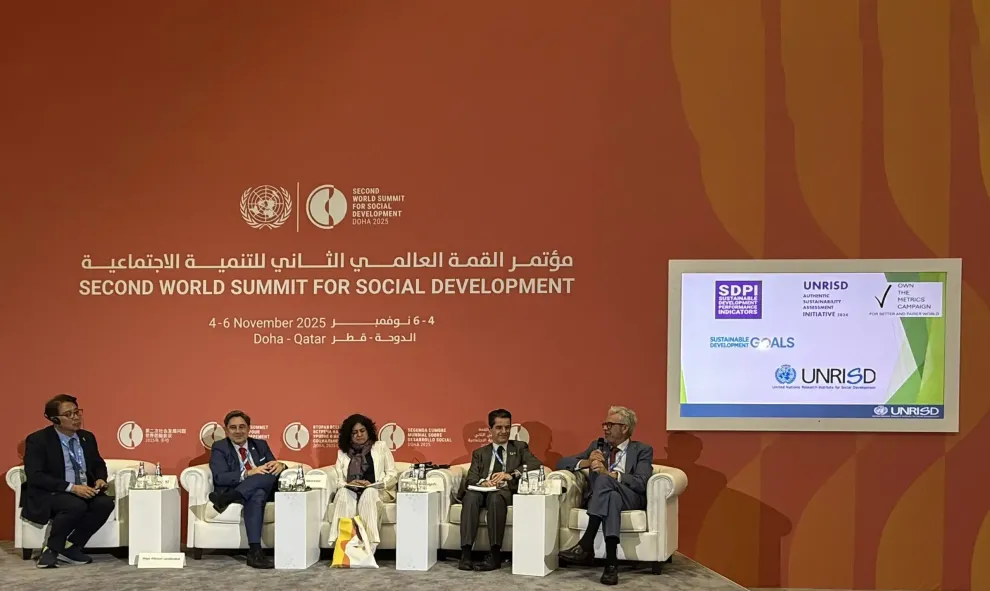
A crucial achievement of the WCS was the adoption of a political declaration by Member States, which officially recognizes cooperatives as leaders of the social and solidarity economy: not surprisingly, they bring together one billion members and employ 10% of the world's working population. The document highlighted their direct and essential contribution to SDG 8 (decent work) and SDG 1 (zero poverty), central pillars of the summit.
This declaration was in addition to the UN Secretary-General's previous 2025 report, which already called for stronger policies for the growth of the sector. The announcement of a possible UN resolution to celebrate the International Year of Cooperatives every decade (starting in 2035), shared by Charles Katoanga (UNDESA) and Ariel Guarco (ICA), underscored the movement's permanence on the global agenda.
Cooperative health stands out at roundtable
COPAC dedicated ICA 2025 to raising the visibility of the cooperative movement through knowledge sharing and policy dialogue. As a result of this work, a series of policy briefs were produced documenting the contribution of cooperatives to the achievement of the Sustainable Development Goals with examples from various regions.
The practical impact of the model was discussed at a roundtable of cooperative leaders, part of Cooperative and Mutuals 50 (CM50). Moderated by Shaun Tarbuck (ICMIF), the panel included representatives from vital sectors such as insurance, retail, finance, and agriculture. In this influential group, Carlos Zarco, CEO of Spain's Fundació Espriu, represented the healthcare sector. His participation illustrated how the cooperative model offers concrete solutions in critical areas, highlighting its relevance beyond the economy and within social welfare.
The panel participants agreed that the cooperative system, by putting people at the center of decision-making, achieves superior results. These include a fairer distribution of profits, higher wages, and greater long-term stability, making social development more equitable and sustainable.
Tools for the future of cooperation
In the run-up to the Summit, on November 3, 2025, the cooperative movement launched three essential tools to consolidate its global position. The CM50 Manifesto, entitled A Contract for a New Global Economy, was a call to public policy makers. This urgent contract calls for the adoption of five priority commitments, such as the official recognition of the cooperative model and its integration into national SDG strategies.
Other tools presented were the ICA's 2026-2030 strategy (“Practice, Promote, and Protect”) and the special edition of the World Cooperative Monitor (WCM). This report revealed that the top 300 cooperatives had a combined turnover of $2.79 trillion in 2023, a figure that highlights the immense economic capacity of the sector, led by organizations such as Groupe Crédit Agricole (France) and State Farm (USA).
The closing of the International Year of Cooperatives in Doha, with the strong support of the UN and the demonstration of the model's effectiveness in sectors such as healthcare through voices such as that of Carlos Zarco, lays the foundation for the next decade. This international recognition provides a framework and renewed responsibility for the movement. The challenge now lies in translating these commitments and recognition into stronger regulatory frameworks and tangible support policies that enable cooperatives to scale up their impact and ensure that their vision of a fairer global economy is realized in communities around the world.