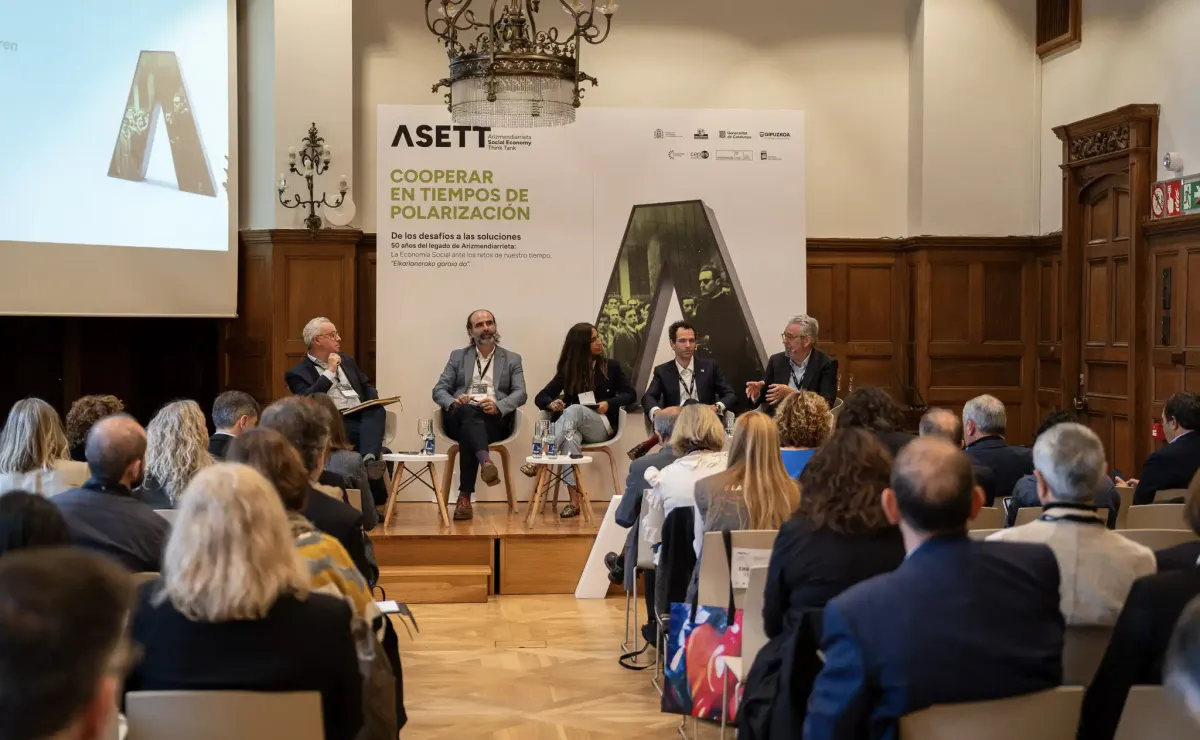
The Social Economy is seeking to position itself at the forefront of solutions to some of today’s most pressing challenges. That was one of the main conclusions of the conference Cooperating in Times of Polarisation: From Challenges to Solutions, organised by Asett (Arizmendiarrieta Social Economy Think & Do Tank) at the Miramar Palace in Donostia-San Sebastián, marking the 50th anniversary of the death of José María Arizmendiarrieta, the driving force behind the cooperative movement that later evolved into Mondragon.
The event brought together institutional representatives, academics and leaders from Social Economy organisations to discuss issues ranging from access to housing and the sustainability of healthcare systems to the transformation of work and social cohesion. The shared objective was to analyse how participation-based models, shared governance and strong local roots can provide viable solutions in a context shaped by economic uncertainty, technological disruption and growing social polarisation.
For the organisers, Arizmendiarrieta’s legacy remains highly relevant. During the event, Asett’s general director, Iñigo Albizuri, argued that cooperation continues to be an effective way of addressing complex challenges while keeping people at the centre of economic activity.
A model looking towards 2040
One of the highlights of the conference was the presentation of the Delphi Study on the Future of Organisations and the Social Economy in 2040, developed by Asett’s foresight division. The report examines how demographic ageing, talent shortages, technological acceleration and geopolitical shifts are expected to reshape organisations over the coming years.
According to the study, innovation, artificial intelligence, lifelong learning and inter-organisational collaboration will become essential factors in maintaining business competitiveness. At the same time, it identifies significant opportunities in sectors such as care, healthcare and climate transition, all of which are expected to play an increasingly important role in economic development and job creation.
Against this backdrop, advocates of the Social Economy argue that it can offer unique advantages through more participatory governance models and stronger links to local communities. Experts attending the conference stressed that these characteristics may prove particularly valuable in a changing labour market where attracting and retaining talent is becoming a strategic priority.
The future of work was a recurring theme throughout the discussions, with representatives from the Basque and international cooperative movements emphasising the need to combine competitiveness with social commitment in order to respond effectively to emerging economic demands.
Housing, healthcare and care services as areas of innovation
Beyond strategic reflection, the conference showcased a number of concrete initiatives developed within the Social Economy ecosystem. These included Lanagro, focused on agricultural employment and territorial development, as well as projects aimed at transforming home-based care services.
These initiatives are part of Asett’s Social Lab, a platform that connects businesses, public institutions, universities and social organisations to identify successful practices and facilitate their replication in other regions. The underlying idea is straightforward: sharing knowledge can accelerate solutions that are already proving effective in areas of critical importance for society.
The sustainability of healthcare systems was another major topic of discussion. In this field, special attention was given to the contribution of Carlos Zarco, medical director of Fundación Instituto San José University Hospital and a recognised voice in healthcare and social innovation. Zarco highlighted the need for more collaborative, people-centred care models capable of responding to demographic ageing and the growing demand for healthcare services.
Housing also featured prominently on the agenda. Participants examined cooperative housing experiences and user-ownership models designed to improve access to affordable and stable housing. They also addressed the barriers these initiatives face, particularly regarding financing, land availability and regulatory frameworks.
The European dimension completed the programme. Juan Antonio Pedreño, president of https://www.socialeconomy.eu.org/ and CEPES, pointed to the growing institutional recognition of the Social Economy within the European Union. He noted that an increasing number of countries have introduced dedicated legislation to support the sector and welcomed backing from the European Parliament for making the Social Economy a priority within the next Multiannual Financial Framework for 2028-2034.
Fifty years after Arizmendiarrieta’s death, the message emerging from Donostia was clear: cooperation continues to provide answers to highly contemporary challenges. At a time of uncertainty and social fragmentation, supporters of the Social Economy argue that sharing risks, knowledge and objectives can be not only a business alternative, but also an effective way of building more cohesive and resilient societies.