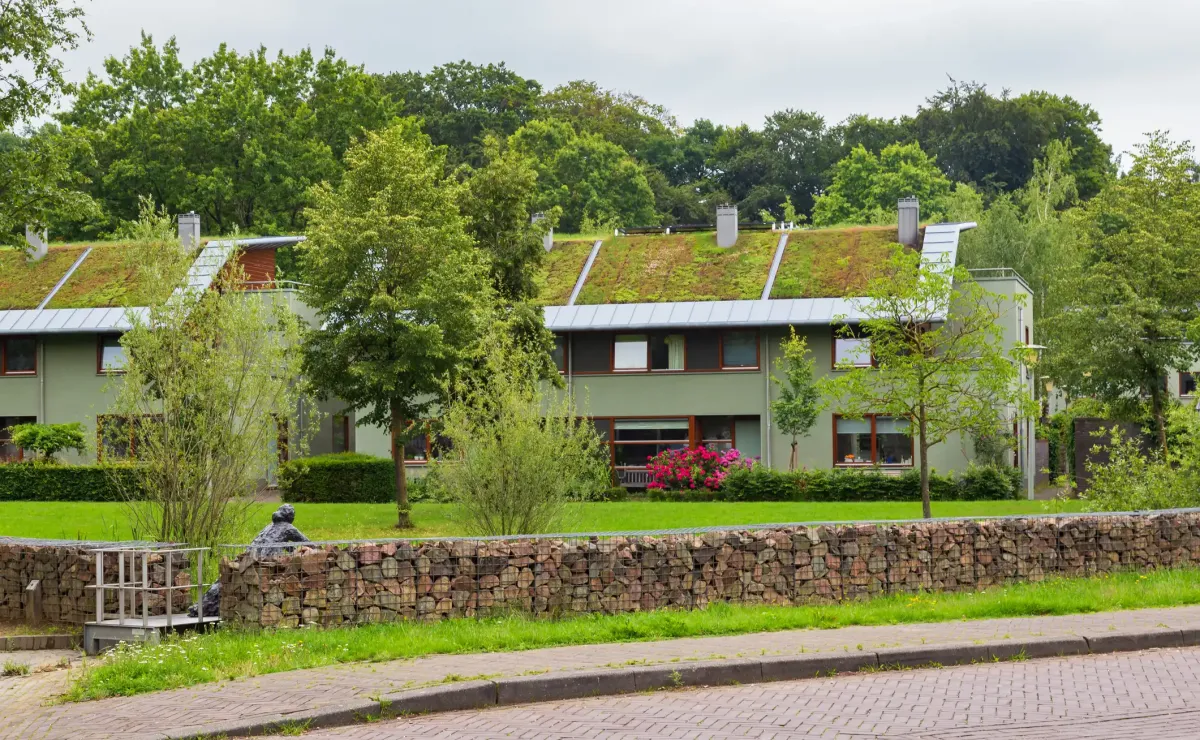
If we analyze current trends in workplace democratization and sustainability, by the year 2050 cooperativism might not be a marginal alternative, but rather the backbone of the global economy. The digital transition and the climate crisis point to a profound transformation across key sectors.
1. Housing: From Speculative Markets to Right of Use
Access to housing would undergo a structural metamorphosis. Projections for 2050 suggest that the ecological cohousing model based on right-of-use could become the primary option in urban areas. In this scenario, traditional private ownership and real estate investment funds would lose ground to housing cooperatives. Because the property remains permanently owned by the cooperative, speculation would be eliminated at its root, guaranteeing members a lifelong right of use at prices tied strictly to the actual cost of maintenance.
2. Employment and Tech: The End of Pyramidal Corporations
Under this future-oriented approach, automation and artificial intelligence would not destroy jobs, but force a major reorganization of work. The top-down corporations of the 20th century would give way to platform cooperatives, where developers and technical professionals own the software themselves. In 2050, strategic decisions would be made horizontally, and surpluses would be distributed equitably. The primary goal of technology would no longer be maximizing value for an external shareholder, but reducing the workweek to around 25 hours, prioritizing well-being.
3. Utilities and Consumption: Local, Decentralized Networks
The energy and food distribution sectors would transition to operate through community-owned networks. Cities could achieve energy self-sufficiency via renewable energy cooperatives, transforming neighborhoods into interconnected solar microgrids. At the same time, massive food oligopolies would be replaced by local cooperative supermarkets (Km 0). The use of social currencies, managed by ethical and cooperative banking systems, would ensure that capital impacts only the real economy.
Ultimately, looking ahead to 2050 isn't about chasing a utopia; it's a logical next step. The crises of the 21st century are proof that endless growth just doesn't work. When the dust settles, the organizations that actually survive the coming decades won't be the ones squeezing every last penny for external shareholders, but those that realize real value is something you build and share with the community.