International Year of Cooperatives
The UN establishes the International Year of Cooperatives every ten years
With this move, cooperativism achieves unparalleled recognition within the international economic context
The cooperative movement at the service of social medicine


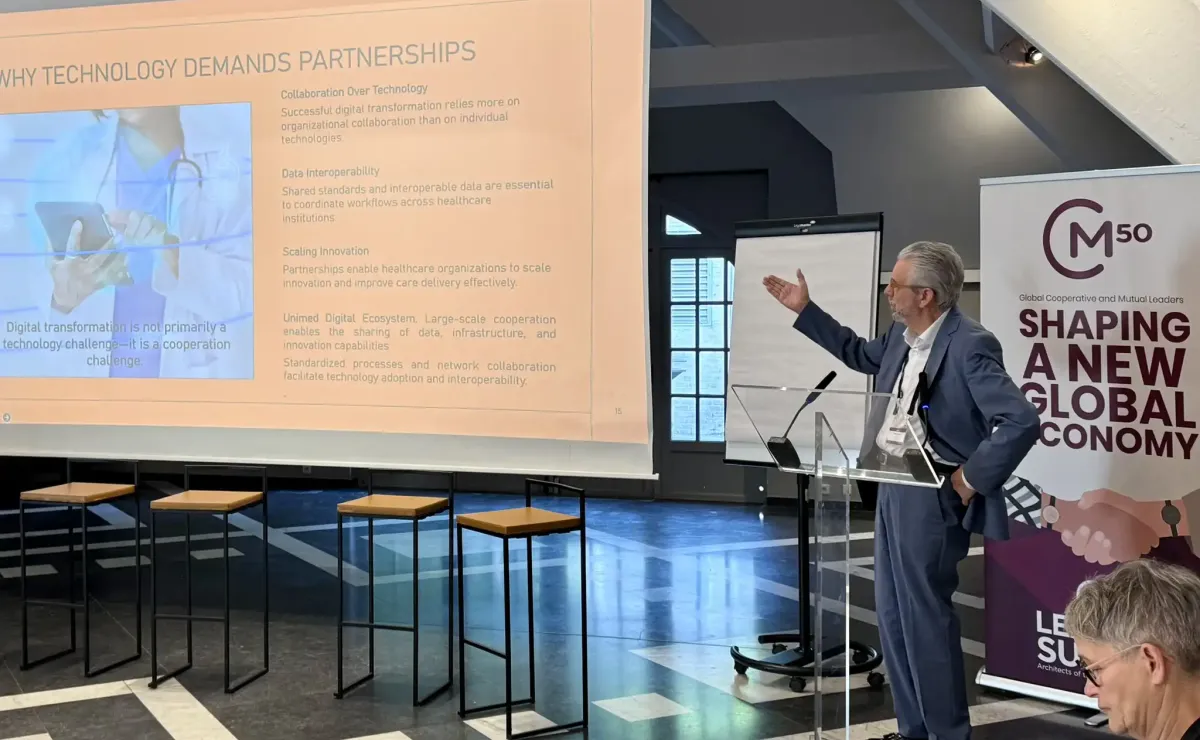
Brussels hosted the
Far from being a marginal sector, this group of companies generates hundreds of billions in annual turnover. Their current goal is as clear as it is ambitious: to act as the architects of a new global economy and double the value of the cooperative economy from 2.7 to 5 trillion dollars by the year 2035.
In this context, the CEO of the Espriu Foundation, Carlos Zarco, took on a leading role by participating in the panel "Cooperative Business to Business as the future of a New Global Economy". This session directly addressed the B2B market pillar of the CM50, designed to transform multinational inter-cooperation into a deliberate strategy for large-scale business growth.
Furthermore, the Espriu Foundation participated in the presentation of the Healthy Food Systems project, in collaboration with the Indian company IFFCO and the Acorn platform of the cooperative bank Rabobank. The initiative, aligned with the innovative One Health approach, seeks to sustainably connect farmland with human diets through three critical areas: regenerative agriculture, fair pricing mechanisms for carbon sequestration, and the promotion of healthy diets through the involvement of agricultural, financial, food distribution, and health cooperatives.
The summit also served to delve into the other core commitments of the CM50, most notably Coop Cloud, a sovereign digital infrastructure equipped with artificial intelligence to unify data ecosystems within the cooperative sector and prevent dependence on other platforms. In the financial sphere, a working group focused on access to capital was introduced, dedicated to designing specific investment instruments tailored to the cooperative model. Regarding education and leadership, the summit agreed on the creation of accredited university programs and the Purpose-driven Leadership initiative to boost the talent of women and young people. Finally, the commitment to resilient communities will focus on deploying cooperative expertise in health, housing, and food during the reconstruction phases following crises and natural disasters[cite: 1, 2].
This summit represents the consolidation of a strategic journey that began in Madrid in May 2025. The reflections and debates from that foundational event, sponsored by Assistència Sanitària and Asisa, led to the Contract for a New Global Economy, which CM50 members ratified in Doha during the Second World Summit for Social Development.
With the Brussels meeting, the CM50 reaffirms its structure and defines the objectives that will guide its work over the next decade, ensuring that the celebration of the next International Year of Cooperatives in 2035 consolidates the cooperative enterprise model as the cornerstone of a new global economy.

With this move, cooperativism achieves unparalleled recognition within the international economic context

The II World Summit for Social Development concluded on Thursday in Doha with a firm demand to member countries: move quickly from commitments to practical implementation. The primary goal is to ensure that the Doha Political Declaration translates into quantifiable progress across three fundamental pillars: poverty reduction, the creation of decent work, and the promotion of social inclusion.